
Physics & Philosophy
Wolfgang Pauli, Carl Jung and Synchronicity: When a Nobel Physicist Took Meaningful Coincidence Seriously
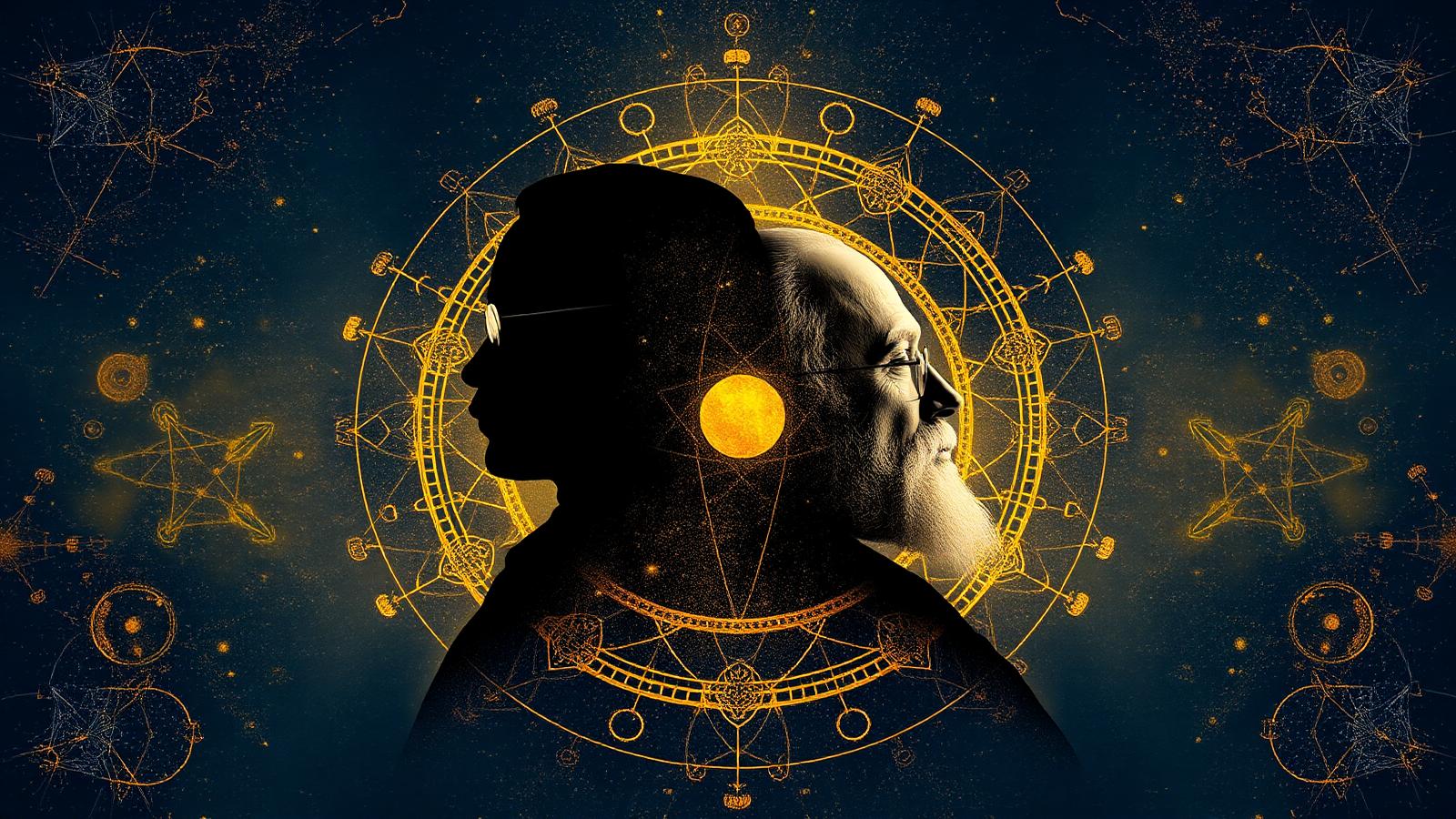
Wolfgang Pauli was one of the sharpest minds in twentieth century physics. He won the Nobel Prize for the exclusion principle, was feared for a critical style so severe colleagues called it the Pauli effect, and helped shape quantum mechanics from the inside. He was also, quietly, one of Carl Jung's closest intellectual collaborators, and together they built the theory of synchronicity. This is the story of how a founder of quantum physics came to believe that meaningful coincidence was pointing at a deeper order, and why that idea still matters.
Who was Wolfgang Pauli?
Pauli was a child prodigy who wrote a review of general relativity at nineteen that Einstein described as mature enough to have come from a much older man. By his mid twenties he had formulated the exclusion principle, the rule that no two electrons can occupy the same quantum state, which explains the structure of the periodic table and the stability of matter itself. He won the Nobel Prize for it in 1945. Inside physics he was known for a merciless intellectual honesty. Outside physics, almost no one realised how much of his inner life was spent on questions the discipline refused to touch.
The crisis that sent Pauli to Jung
In the early 1930s Pauli was in a personal collapse. A brief first marriage had ended, his mother had recently died, and he was drinking heavily. On his father's suggestion he wrote to Carl Jung in Zurich. Jung did not treat Pauli directly at first. He sent him to one of his younger analysts, Erna Rosenbaum, with instructions to record his dreams without interpretation.
Pauli produced more than a thousand dreams over the following years. Jung eventually used a selection of them, anonymised, in his book Psychology and Alchemy. The physicist who had reshaped quantum theory turned out to be dreaming in the symbolic language of alchemy, mandalas, and the reconciliation of opposites. That coincidence was itself part of what launched the collaboration.
What synchronicity actually means
Jung coined the term synchronicity for events linked not by cause and effect but by meaning. Pauli's contribution was to insist that a serious theory of synchronicity had to sit alongside the physics of his day, not below it. Their joint 1952 book, The Interpretation of Nature and the Psyche, contained Jung's essay Synchronicity: An Acausal Connecting Principle and Pauli's essay on the influence of archetypal ideas on the scientific theories of Kepler.
Together they proposed that alongside the three familiar axes of physics: space, time, and causality, there might be a fourth, an acausal connecting principle. In this picture, mind and matter are not two separate substances but two aspects of a single underlying reality, and meaningful coincidence is the visible edge of that unity.
Why a quantum physicist found this plausible
Pauli's willingness to entertain synchronicity was not a lapse of scientific rigor. It grew out of what quantum mechanics had already forced physicists to accept. The observer could not be cleanly separated from the observed. Non-locality suggested that distant particles could remain correlated in ways classical physics could not explain. Determinism at the level of individual events had failed. If reality at the smallest scales was already this strange, the idea that meaning could be a real feature of the world was, for Pauli, no wilder than what his own equations were saying.
The Pauli, Jung letters
Their correspondence, published as Atom and Archetype, spans nearly twenty five years. Pauli wrote to Jung about dreams of a physicist wandering through corridors of mirrors, about a figure he called the dark stranger, and about a symbol he named the world clock, a rotating structure of interlocking rings that appeared in his dreams and struck him as an image of the unity of physics and psyche.
In the letters Pauli returned repeatedly to a concept he called the resurrection of spirit, his shorthand for the reintegration of meaning, soul, and inner life into a scientific worldview that had spent three centuries banishing them. He believed that western science had bought its precision at the cost of splitting the world in two, and that the psychological work he was doing with Jung was pointing at how that split might one day be healed.
The Pauli effect and the physicist as observer
Colleagues joked about the Pauli effect, the strange tendency for laboratory equipment to fail whenever Pauli entered the room. He was aware of the reputation and half serious about it. For him it was a small everyday reminder that the boundary between the psyche of the observer and the behaviour of the physical world was not as solid as the textbooks pretended.
Where Bohm picks up the thread
David Bohm, the physicist behind the implicate order, arrived at strikingly similar conclusions a generation later without needing to invoke synchronicity by name. Bohm proposed that the universe we experience is an explicate order unfolding from a deeper enfolded whole, in which every region carries information about the entire structure. In that framework, two events that share meaning can be expressions of the same underlying movement, exactly what Pauli and Jung were trying to describe. Bohm and Jung never collaborated, but Bohm engaged seriously with depth psychology and often spoke of consciousness as inseparable from the ground of physics.
Where mainstream science stands now
There is no accepted physical experiment that proves synchronicity, and no orthodox theory in which an acausal connecting principle appears. What has changed is the willingness of thoughtful physicists and philosophers to admit that quantum mechanics does not sit comfortably with a purely mechanical picture of the world. Non-locality, contextuality, and the ongoing puzzle of the observer keep the door open to precisely the questions Pauli was already asking in the 1940s.
Why this still matters
- Pauli was not a mystic pretending to be a physicist. He was a Nobel laureate insisting that a full account of reality had to include the observer and the meanings they carry.
- Synchronicity, taken seriously, reframes coincidence as data about the structure of reality rather than an embarrassment.
- The Pauli, Jung project remains one of the most careful attempts to bring physics and depth psychology into a single conversation.
- Its questions have only sharpened as physics has continued to bump up against the observer, information, and the limits of the classical worldview.
Where to go next
- Read our companion piece on David Bohm and synchronicity to see how the implicate order picks up the Pauli, Jung thread.
- Explore our guide to the observer effect for the experiment that first forced physicists to reckon with the role of the mind.
- Watch Infinite Potential to meet the physicist who spent his life arguing that consciousness and matter belong to one unbroken order.
Share this article