Consciousness & Reality
What Is Sacred Geometry? Symbols, Meanings and the Science of Pattern
Sacred geometry is the study of shapes, ratios and patterns that appear again and again in nature, in art and in the world's spiritual traditions, and the claim that those patterns say something meaningful about the structure of reality. Some of it is measurable physics and mathematics. Some of it is symbolism and meaning making. This guide separates the two honestly, explains the main symbols, and shows why the underlying question, whether reality has a deep hidden order, is one that serious physicists have taken seriously too.
What is sacred geometry?
Sacred geometry is a name for the ancient practice of treating geometric form as more than decoration. Across Egypt, Greece, India, China, the Islamic world and medieval Europe, builders, mystics and mathematicians noticed that a small family of shapes and proportions kept reappearing: the circle, the spiral, the hexagon, the triangle, the five Platonic solids, and ratios such as the golden ratio. They treated those forms as a language, a way of pointing at an order that seemed to run underneath the visible world.
Two distinct claims usually travel under the same name, and it helps to keep them apart. The first is descriptive and testable: certain geometric patterns really do recur throughout nature, from crystal lattices to sunflower seed heads to galaxy arms, for reasons physics and biology can explain. The second is interpretive: those patterns are evidence of intelligence, meaning or consciousness built into reality. The first claim is mathematics. The second is philosophy, and it is where the interesting argument lives.
The main sacred geometry symbols and their meanings
The circle and the vesica piscis
The circle is the starting point of almost every sacred geometry system: one centre, one radius, no beginning and no end. Overlap two circles of equal size so each passes through the other's centre and the lens shape between them is the vesica piscis. Traditionally it symbolises the meeting of two worlds, and mathematically it is the seed from which almost every other construction in the tradition can be drawn with only a compass and a straight edge.
The Seed of Life and the Flower of Life
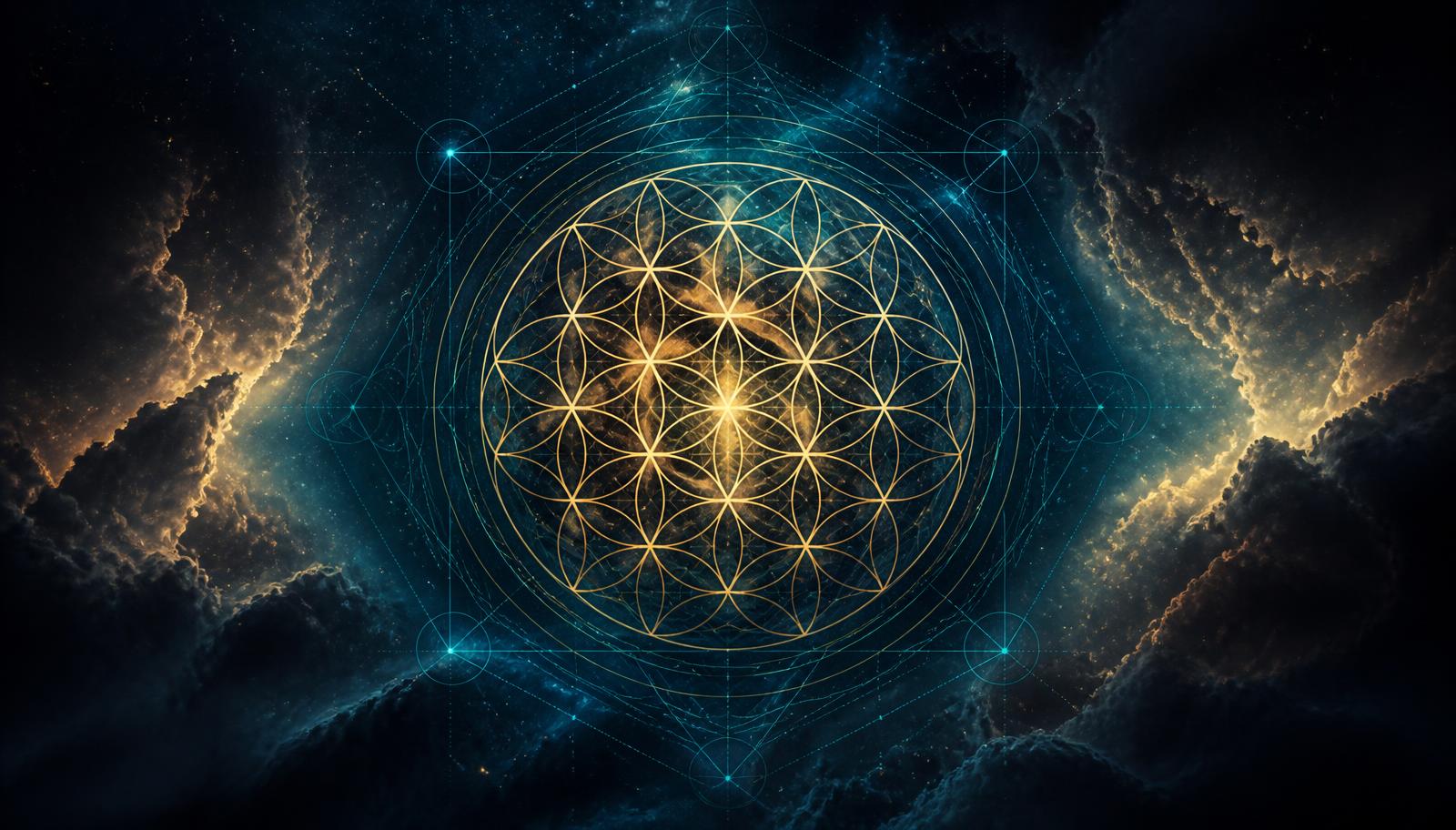
Add six more circles around a central one and you get the Seed of Life, a seven circle rosette. Keep extending the same rule outward and the pattern becomes the Flower of Life, the familiar interlocking rosette carved into the walls of the Temple of Osiris at Abydos in Egypt and found in Islamic, Chinese and European art. It is usually read as a symbol of unfolding creation: one simple rule, repeated, generating endless structure. Notice that the hexagonal packing it produces is exactly how circles pack most efficiently in a plane, which is why the same lattice shows up in honeycombs and in snowflakes.
Metatron's Cube
Metatron's Cube is drawn by connecting the thirteen circle centres of the Fruit of Life with straight lines. Its interest is not mystical bookkeeping but the fact that the resulting figure contains two dimensional projections of all five Platonic solids, which makes it a compact visual index of the tradition's core forms.
The five Platonic solids
The tetrahedron, cube, octahedron, dodecahedron and icosahedron are the only five convex solids whose faces are identical regular polygons meeting identically at every vertex. That is a proved theorem, not a belief: there are exactly five, and there can never be a sixth. Plato assigned them to fire, earth, air, aether and water in the Timaeus, an early and wrong physical theory but a serious attempt at one. Their real significance today is structural, since these symmetries govern crystal forms, molecular geometry and the shells of many viruses.
The golden ratio and the Fibonacci spiral
The golden ratio, roughly 1.618, is the proportion where the whole relates to the larger part as the larger part relates to the smaller. Ratios of consecutive Fibonacci numbers converge on it. In plants it appears as the divergence angle between successive leaves or seeds, close to 137.5 degrees, because that angle packs new growth with the least overlap and the best light exposure. This is the clearest example of the honest version of sacred geometry: a beautiful proportion that recurs in nature for a concrete, explainable reason.
The torus, the spiral and the mandala
Toroidal flow, logarithmic spirals and mandalas complete the standard vocabulary. Spirals appear in nautilus shells, hurricanes, water vortices and galaxies because growth and rotation under similar constraints produce similar curves. Mandalas, in Tibetan Buddhist and Hindu practice, are less about cosmology than about attention: a symmetrical form used to gather and steady the mind.
Where the patterns really do appear in nature
- Hexagonal packing in honeycombs, basalt columns, snowflake growth and graphene, because hexagons tile a plane with the least perimeter for the area enclosed.
- Fibonacci and golden angle arrangements in sunflower heads, pine cones, pineapples and the branching of many plants, driven by efficient packing and light capture.
- Platonic and near Platonic symmetry in crystal lattices, molecular structures and icosahedral virus capsids, where minimal energy configurations favour high symmetry.
- Logarithmic spirals in shells, cyclones, whirlpools and spiral galaxies, produced by self similar growth or rotation.
- Fractal branching in trees, river deltas, lungs, blood vessels and lightning, where the same rule repeats at many scales.
None of this requires mysticism to be astonishing. Nature repeats a small set of forms because physical law repeatedly favours the same efficient solutions. The genuinely open question is why mathematics describes the physical world so well in the first place, a puzzle the physicist Eugene Wigner famously called the unreasonable effectiveness of mathematics.
What physics actually says
Modern physics does not endorse the idea that drawing a Flower of Life changes matter, or that specific frequencies carry fixed spiritual meanings. What it does say is stranger and more interesting: the deep structure of physical law is governed by symmetry. Conservation laws follow from symmetries by Noether's theorem. The standard model of particle physics is organised by symmetry groups. General relativity describes gravity as geometry. In real physics, geometry is not a metaphor for structure, it is the structure.
That is why the intuition behind sacred geometry has survived contact with science even where its specific claims have not. The intuition is that reality is not an accidental pile of separate things but an ordered whole with pattern all the way down. Physics states a rigorous version of that intuition and then holds it to evidence.
David Bohm, wholeness and the order behind the pattern
The physicist David Bohm, a colleague of Einstein and one of the twentieth century's most original thinkers about quantum theory, spent his later career on exactly this question. His proposal, the implicate order, was that the world we see, made of separate objects in space, is an unfolded expression of a deeper enfolded order in which everything is internally related to everything else. His favoured analogy was the hologram, where each region of the plate carries information about the whole image.
Read through Bohm, sacred geometry looks less like magic and more like an old, intuitive attempt at a real idea. Recurring form is what a single underlying order looks like when it unfolds into many local situations. Bohm would insist on the discipline: propose, formalise, test. But he took the underlying perception seriously, that fragmentation is something our thinking imposes, and that wholeness is the more accurate description of what is actually there.
"The word measure has a common root with the Sanskrit maya, illusion. Measure is not primarily a physical fact but an insight into order."Paraphrasing a theme from David Bohm, Wholeness and the Implicate Order
How to use sacred geometry without fooling yourself
- Use it as a lens for attention. Drawing or contemplating these forms is a real practice of focus, closer to meditation than to engineering.
- Keep description separate from interpretation. Say that hexagons recur because they tile efficiently, then treat any meaning you draw from that as your interpretation, clearly labelled.
- Be sceptical of health and frequency claims. Assertions that a symbol, tone or crystal shape produces a specific measurable physical or medical effect are not supported by evidence.
- Learn the actual mathematics. Compass and straight edge construction, tiling, symmetry groups and the Fibonacci sequence are more rewarding than any secret meaning attached to them.
- Follow it to the real frontier. The serious version of this curiosity leads to symmetry in physics, the foundations of quantum theory, and the question of consciousness.
Common questions
How many sacred geometry symbols are there?
There is no fixed canon, because sacred geometry is a tradition rather than a standardised system. Most modern accounts centre on roughly ten to fifteen core forms: the circle, vesica piscis, Seed and Flower of Life, Metatron's Cube, the five Platonic solids, the golden ratio and its spiral, the torus and the mandala. The only strictly bounded set among them is the Platonic solids, where exactly five exist.
Is sacred geometry a science?
The geometry itself is mathematics, and the recurrence of these patterns in nature is well documented science. The spiritual interpretation is not science, because it does not make testable predictions. Both can be held at once, as long as you are honest about which one you are speaking.
Why do people see geometric patterns in altered states?
Reports of lattices, tunnels, spirals and cobweb forms in psychedelic, migraine and near sleep states are strikingly consistent, and researchers have catalogued them as form constants. The leading explanation is that they reflect the geometry of visual cortex organisation rather than an external structure being perceived. Whether that fully settles the question is a live debate in consciousness studies.
Is the golden ratio really everywhere?
It is genuinely present in plant growth patterns and in some spiral forms. It is often overclaimed in art, architecture and human anatomy, where measurements are frequently selected after the fact to fit. Trust the botanical cases, and be careful with the rest.
Why this question matters
Sacred geometry endures because it points at something people sense and struggle to articulate: that reality has a coherence to it, and that we are part of that coherence rather than observers standing outside it. Strip away the overclaiming and a serious question remains, one that runs from Plato through Kepler to Bohm and into current work on quantum foundations and consciousness. That question, whether the universe has a deep undivided order and what it means for us if it does, is the question our films exist to explore.
Share this article