Physics & Philosophy
Quantum Entanglement Explained: Spooky Action and What It Really Means
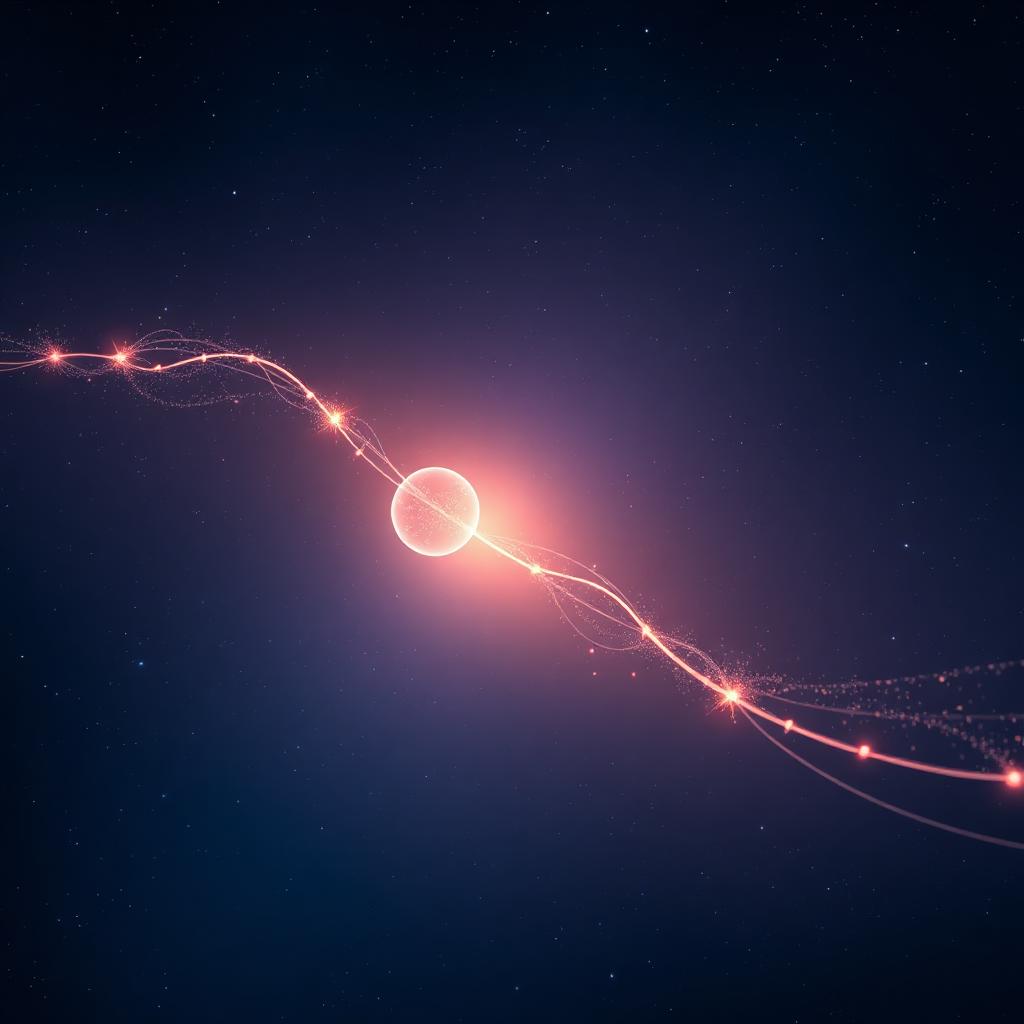
Quantum entanglement is the strangest confirmed fact in physics. Two particles, once linked, seem to respond to each other instantly across any distance. Einstein called it spooky. Experiments have proven it is real. But what does it actually mean, and why should anyone outside a lab care?
What entanglement is
When two particles interact in the right way, their properties become correlated in a way classical physics cannot explain. Measure one and you instantly know something about the other, no matter how far apart they are. The correlation is not because the answer was set in advance. It is because, in a deep sense, the two particles were never quite separate to begin with.
Einstein's objection: the EPR paradox
In 1935 Einstein, Podolsky and Rosen argued that if quantum mechanics predicts this kind of correlation, then quantum mechanics must be incomplete. There had to be hidden variables carrying the answer with each particle. Anything else, Einstein said, would require spooky action at a distance, and that violated the spirit of relativity.
Bell's theorem and the experiments that followed
In 1964 John Bell showed that Einstein's hidden variables would predict different statistics than quantum mechanics. That difference could be tested. From Alain Aspect in the 1980s to the loophole-free experiments of the 2010s, the results are consistent and clear. Nature agrees with quantum mechanics. Local hidden variables are ruled out. The 2022 Nobel Prize in Physics recognised this line of work.
What it does and does not mean
- It does not allow faster-than-light communication. You cannot use entanglement to send a message.
- It does mean the world is nonlocal in a precise sense: outcomes far apart are linked in ways no local mechanism can reproduce.
- It powers real technology, including quantum cryptography, quantum computing, and quantum teleportation of states.
Bohm's reading: wholeness under the surface
David Bohm took nonlocality seriously. For him, entanglement was a hint that the universe is not really built out of separate parts. Beneath the world we perceive lies what he called the implicate order, a deeper level in which everything is enfolded into everything else. What looks like two particles is, at a more basic level, one process seen from two angles.
"Ultimately, the entire universe has to be understood as a single undivided whole."David Bohm
Why it matters beyond physics
Entanglement is not a metaphor for human connection, and honest writing about it should not pretend it is. But it does dismantle one very old picture: the idea of a universe made of independent objects, each fully defined on its own. Whatever reality turns out to be, it is more relational, more interwoven, than classical intuition suggested.
Where to go next
- Watch Infinite Potential for David Bohm's reading of nonlocality and wholeness.
- Read Wholeness and the Implicate Order by David Bohm.
- Follow Quantum Convergence for extended conversations with physicists on entanglement and reality.
Share this article