Behind the Films
Paul Howard: The Filmmaker Behind Infinite Potential and Quantum Convergence
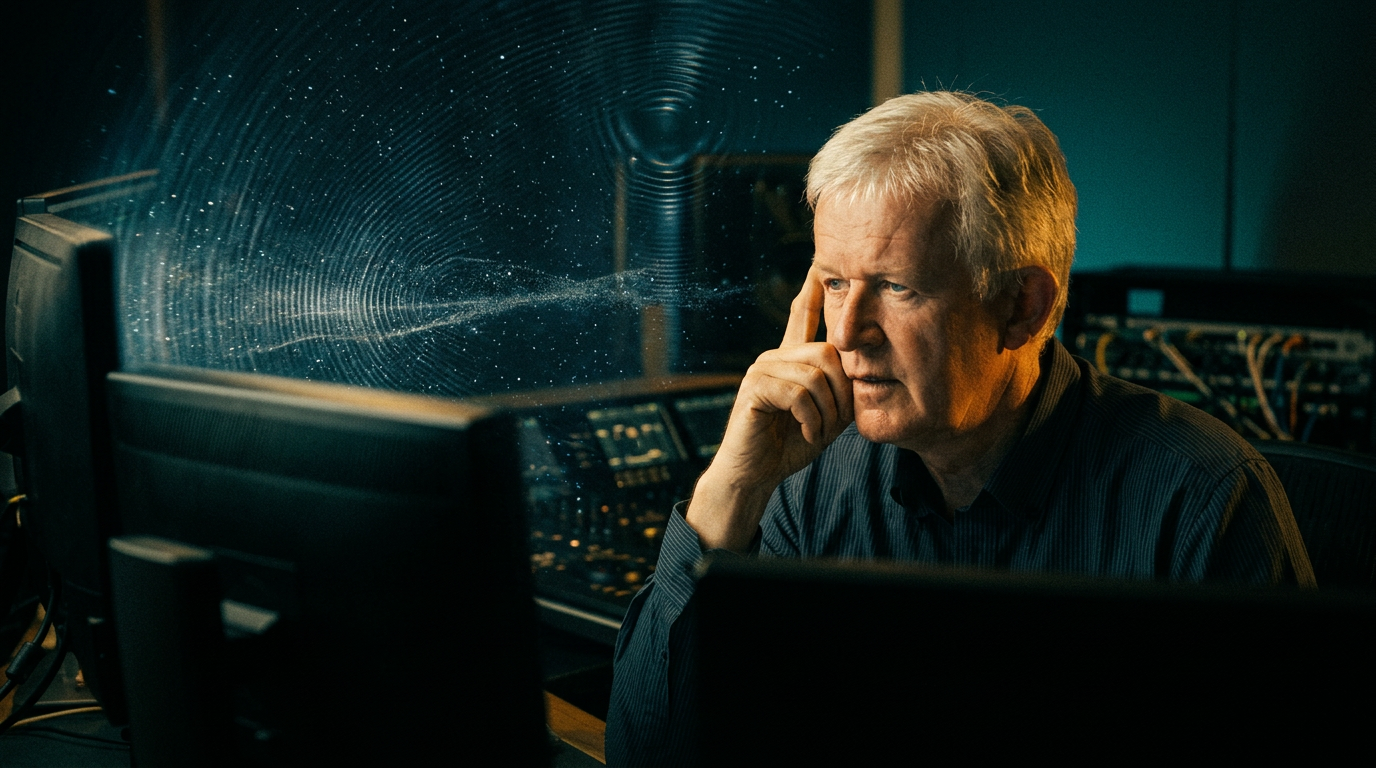
Most documentaries about physics are made by people who came to the subject through science. Paul Howard came to it through forty years of storytelling, and that is precisely why his films land with audiences who would never open a physics book. As director and producer of Infinite Potential: The Life and Ideas of David Bohm and of Quantum Convergence: The New Science of Consciousness, he has built something unusual: a body of work that treats the deepest questions in physics as human drama rather than lecture.
Who is Paul Howard?
Paul Howard is an Irish producer, director and executive producer whose career in feature documentary and multimedia production spans four decades. He has worked across multiple genres, directed and edited critically acclaimed feature documentaries, and served as CEO and director of several independent film companies. He is today CEO of Infinite Potential, the company behind the films, events and educational work that carry David Bohm's ideas to a general audience.
What runs through the whole catalogue is a refusal to condescend. Howard's working assumption is that ordinary viewers can handle genuinely difficult ideas provided the ideas are given a human carrier: a life, a friendship, a loss, a question somebody could not let go of. Get that right and the physics follows the audience home.
Infinite Potential and the decade with David Bohm
In 2020, Howard completed Infinite Potential: The Life and Ideas of David Bohm, the first feature documentary devoted to the physicist Einstein called his spiritual son and the Dalai Lama called his science guru. It was not a quick production. Bohm's story runs through the golden age of quantum theory, the McCarthy hearings, exile from the United States, decades of institutional neglect, and a long friendship with the philosopher J. Krishnamurti that changed both men.
Assembling that meant tracking archive across several countries, filming physicists who had worked alongside Bohm, and finding a shape for a life that ends without a tidy vindication. The film's real achievement is that it holds two things together at once: the technical story of a physicist who challenged the Copenhagen consensus and argued for hidden variables when it cost him his standing, and the interior story of a man convinced that fragmentation in thought was the source of fragmentation in the world.
"Deep down the consciousness of mankind is one. This is a virtual certainty because even in the vacuum matter is one."David Bohm, the line that anchors Infinite Potential
The film found an audience far beyond the physics community, and the reason is instructive. Howard did not build it as an argument for Bohm's interpretation of quantum mechanics. He built it as a portrait of intellectual courage, and let the ideas arrive through the person holding them.
Quantum Convergence: taking on three realities
Howard's most recent completed feature, Quantum Convergence: The New Science of Consciousness (2025), is a harder film to make than its predecessor, because it has no single life to follow. Its subject is a convergence: three descriptions of reality, the classical, the quantum and the conscious, and the growing suspicion among serious researchers that consciousness may belong to the fabric of the universe rather than being an accident produced late by brains.
The film gathers physicists, neuroscientists, philosophers and contemplatives who disagree with each other, and keeps that disagreement on screen. That is a directorial decision with consequences. It would be easier and more commercial to cut a documentary that resolves into a single reassuring thesis. Quantum Convergence instead stages the open question, on the grounds that the frontier is more interesting than a conclusion nobody has earned yet.
- Contributors from experimental physics, foundations of quantum mechanics, consciousness studies and contemplative traditions, in dialogue rather than in sequence.
- A structure built around the hard problem: why physical processes are accompanied by experience at all.
- Bohm's implicate order used as connective tissue, linking wholeness in physics to wholeness in mind.
- A deliberate refusal of the two easy endings, hard materialism on one side and untethered mysticism on the other.
The method: rigour first, wonder second
Ask what distinguishes Howard's films from the wider genre of consciousness documentary and the answer is a discipline about sourcing. Claims are attributed to the people who make them. Speculation is labelled as speculation. Physicists are allowed to say that a popular idea is not supported. In a field crowded with films that use quantum vocabulary as decoration, that restraint is the whole brand.
It also reflects Bohm's own instruction, which Howard has repeated in interviews in various forms: the point is not to arrive at a comforting belief, it is to look at what is actually happening without the interference of what you already want to be true. A film can either flatter an audience's existing convictions or invite it to think. Howard consistently chooses the second, and accepts the smaller, more loyal audience that comes with it.
What Paul Howard is making next
On Dialogue
Currently in production, On Dialogue takes up the practice Bohm developed in his later years: sustained group conversation without an agenda, in which participants suspend their assumptions long enough to see how thought actually moves in a group. Bohm considered it the practical arm of his physics, a route to new perception rather than a technique for reaching agreement. It is a difficult film to make because the subject is a process rather than an event, which is exactly the kind of problem Howard's editing background is suited to.
The Veil of Secrets
In preparation, The Veil of Secrets connects ancient mysticism, rediscovered gospels and modern physics into a single emerging realisation: that what Jesus Christ revealed may not belong to history alone, but to the very structure of reality. On its face it is the largest departure in the catalogue. In practice it is the same instinct as the earlier films, following a question across the boundary where science, text and direct experience meet, and treating that boundary as the interesting place rather than a place to pick a side.
Why these films matter now
Bohm's central worry was fragmentation: that we cut the world into pieces, forget that we did the cutting, then treat the pieces as reality and wonder why everything is in conflict. Sixty years later that diagnosis reads less like philosophy and more like a description of the news. Howard's films are an argument, made in the language of cinema rather than of academic papers, that wholeness is not a spiritual sentiment but a serious hypothesis about how reality is put together, and that taking it seriously changes how a person lives.
Forty years of documentary craft is what makes that argument watchable. Paul Howard is not a physicist explaining physics. He is a filmmaker who decided that the most important story of the century was happening in a field most audiences had been told they could not understand, and then spent a career proving otherwise.
Share this article