Consciousness & Reality
David Bohm and Synchronicity: The Implicate Order as a Physical Basis for Meaningful Coincidence
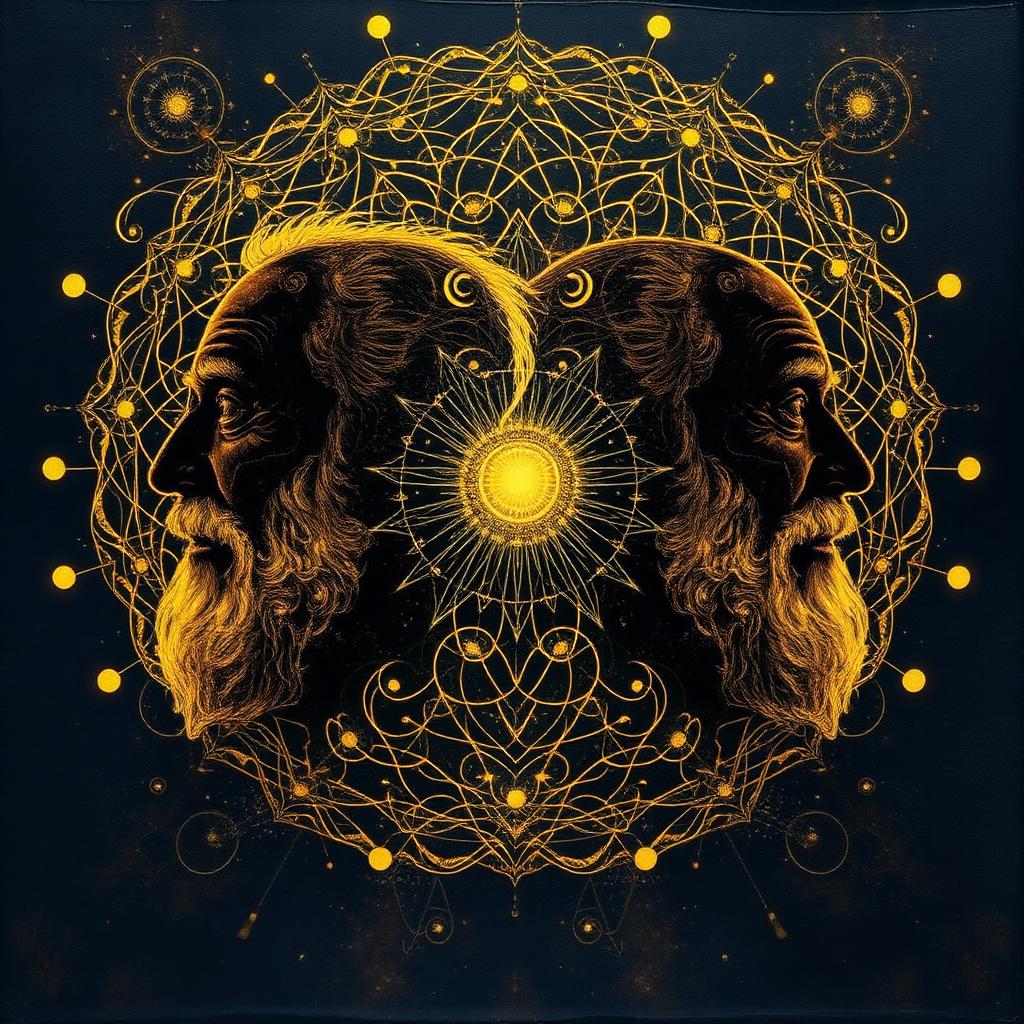
Almost everyone has a story about a coincidence too strange to shrug off. A name spoken aloud minutes before the person calls. A book that falls open at the exact page you needed. Carl Jung called this synchronicity, an acausal connection through meaning. David Bohm, the physicist behind the implicate order, thought Jung was pointing at something real, and that physics itself might one day describe it. This is a careful look at where their ideas meet, and what synchronicity tells us about the deeper structure of reality.
What Jung meant by synchronicity
Jung coined the term synchronicity in the 1950s to describe events that are linked not by cause and effect but by meaning. You think of a childhood friend and a letter from that friend arrives the same afternoon. A patient dreams of a scarab beetle and one taps at the window during the session. Jung took these moments seriously as a psychiatrist, because his patients experienced them as turning points, moments when the inner world and the outer world seemed to click into a shared pattern.
For Jung, synchronicity was not magic and not superstition. It was a principle in nature that operated alongside causality, most visible when the psyche was under pressure, in dreams, in creative breakthroughs, in moments of insight or grief.
Why Jung needed a physicist
Jung knew that a principle of meaningful coincidence would sound mystical to a scientific audience. He wanted a physical grounding for it. He found a first collaborator in Wolfgang Pauli, the Nobel laureate whose work helped define quantum mechanics. Together they wrote The Interpretation of Nature and the Psyche, arguing that quantum physics had already broken the tidy picture of a purely mechanical universe and left room for something like acausal correlation.
Decades later, David Bohm picked up the thread. Bohm and Jung never wrote a book together, but Bohm engaged seriously with Jungian ideas in conversation, in interviews, and in his correspondence with the analyst Ira Progoff and others exploring the meeting of physics and depth psychology.
Bohm's implicate order in one paragraph
Bohm proposed that the world we experience, the explicate order of separate objects in space and time, unfolds from a deeper enfolded reality he called the implicate order. In the implicate order, every region carries information about the whole, the way a hologram encodes the full image in every fragment. Events that look separate on the surface can be intimately connected at the deeper level, without needing signals to travel between them.
How the implicate order grounds synchronicity
If reality is fundamentally an unbroken whole, then two events that share meaning can be expressions of the same underlying movement, even when no causal chain links them in space and time. In this picture, synchronicity is not a violation of physics. It is what you would expect from a universe in which mind and matter are not two separate substances but two aspects of one implicate order.
Bohm put it directly in a 1987 interview with Renee Weber. He said that the implicate order applies to matter and consciousness alike, and that when the two seem to speak to each other through a meaningful coincidence, it is because they are unfolding from the same deeper ground.
Meaning, not mysticism
It is important to be careful here. Bohm was not endorsing the idea that wanting something hard enough makes it happen, or that every coincidence is a sign from the universe. He was making a specific claim, that meaning is not just a subjective overlay we impose on a meaningless world of particles. In the implicate order, information and significance are part of the fabric of reality itself.
That reframing matters. The moment you allow meaning to be a real feature of the world, synchronicity stops being an embarrassing anomaly and becomes a natural signal from a deeper level of order.
What research actually shows
There is no accepted physical experiment that proves synchronicity. There is, however, a large body of clinical and phenomenological work documenting how consistently people experience meaningful coincidence, and how often those experiences accompany psychological change. Researchers such as Bernard Beitman have gathered accounts and proposed frameworks, and physicists sympathetic to Bohm continue to argue that a fuller theory of the quantum world will need to account for the observer's role.
The honest position is that synchronicity is real as a class of human experience, and that the deepest physics we have is compatible with it, even if not yet able to describe it precisely.
How to work with synchronicity in daily life
- Notice without inflating. When a striking coincidence lands, write it down, but resist the urge to build a whole cosmology on top of a single moment.
- Ask what the moment is pointing at, not what it is predicting. Synchronicity tends to arrive around thresholds, choices, and unfinished questions.
- Watch for patterns across weeks and months. A single event is data. A recurring theme is a signal worth sitting with.
- Keep it grounded. The most useful response to meaningful coincidence is usually action in the outer world, a conversation, a decision, a change of direction.
Where the deeper question leads
Synchronicity forces a question that mainstream science has been happy to leave alone. If mind and matter are two faces of one order, then consciousness is not a late arrival in a dead universe. It is woven into the ground of things. Bohm believed this. Jung believed this. Ancient traditions from Vedanta to contemplative Christianity have said something similar in their own language for centuries.
You do not need to settle the metaphysics to take the experience seriously. You only need to be willing to notice when the world speaks back, and to listen with the same care you give to your own thoughts.
Where to go next
- Read our introduction to David Bohm and the implicate order to see the physics behind this framework.
- Explore our guide to quantum consciousness for the wider debate about mind and matter.
- Watch Infinite Potential, the documentary on David Bohm's life and vision, for the human story behind the ideas.
- Join a live event to sit with these questions in real conversation.
Share this article